
It is a Tuesday and you are wrapping a truck. New logo, phone number, a photo of the last kitchen you gutted, your website across the tailgate. It looks sharp in the parking lot. What you do not know, because nobody tells you until it costs money, is that in California that truck is now missing something the state requires on it, and a competitor who wants your territory can report it with a photo from their phone. Same story with the website you just paid for, the auto-text your system fires when you miss a call, and the estimate you close on a homeowner’s kitchen table. Every one of those is regulated, and none of the rules live where you would think to look.
Here is the short version. Most of your marketing touches at least one law, and the three that bite hardest are all fixable on a website or in your CRM. First, your license number has to appear on your advertising in most licensed states, your website and trucks included, and California will fine you for leaving it off. Second, the automated texts you send leads need documented consent before you send them, or you are exposed under the TCPA. Third, if you sign a contract at the customer’s home, federal law gives them three business days to cancel and makes you hand them a written cancellation notice. Get these three right and you have closed the gaps that actually get small builders fined or sued. This post gives you the rules, the exact copy to put on your site and in your texts, how each one breaks, and where the answer changes state to state.
In this post
- What counts as “advertising” when the state is reading it
- Do you even need a license, and the number that goes on everything
- Steal this: the compliant lines for your site, truck, and cards
- The texts you send leads: what the TCPA actually requires
- The estimate you sign at the kitchen table: the three-day rule
- The purely local one: lien preliminary-notice deadlines
- Run it three ways: solo, mid-size, and multi-state
- The objections I hear
- Frequently asked questions
- Sources
What counts as “advertising” when the state is reading it
When you hear “advertising,” you picture a billboard or a Facebook ad. A state contractor board reads the word far wider: advertising is anything you use to solicit work. Your website and every page on it, your Google Business Profile, your Instagram and Facebook profiles, the magnet on your truck door, business cards, yard signs, flyers, a radio spot, and your marketplace listings on Houzz, Angi, or Thumbtack.
That matters because the most common contractor advertising rule, the one that gets small operators cited, is a disclosure rule: a specific piece of information has to appear on all of that. In the states that license contractors, that piece of information is your license number. Nobody is asking you to change your message. They are asking you to stamp a number on every surface you use to get a job, and most builders stamp it on the contract and forget the website and the truck.
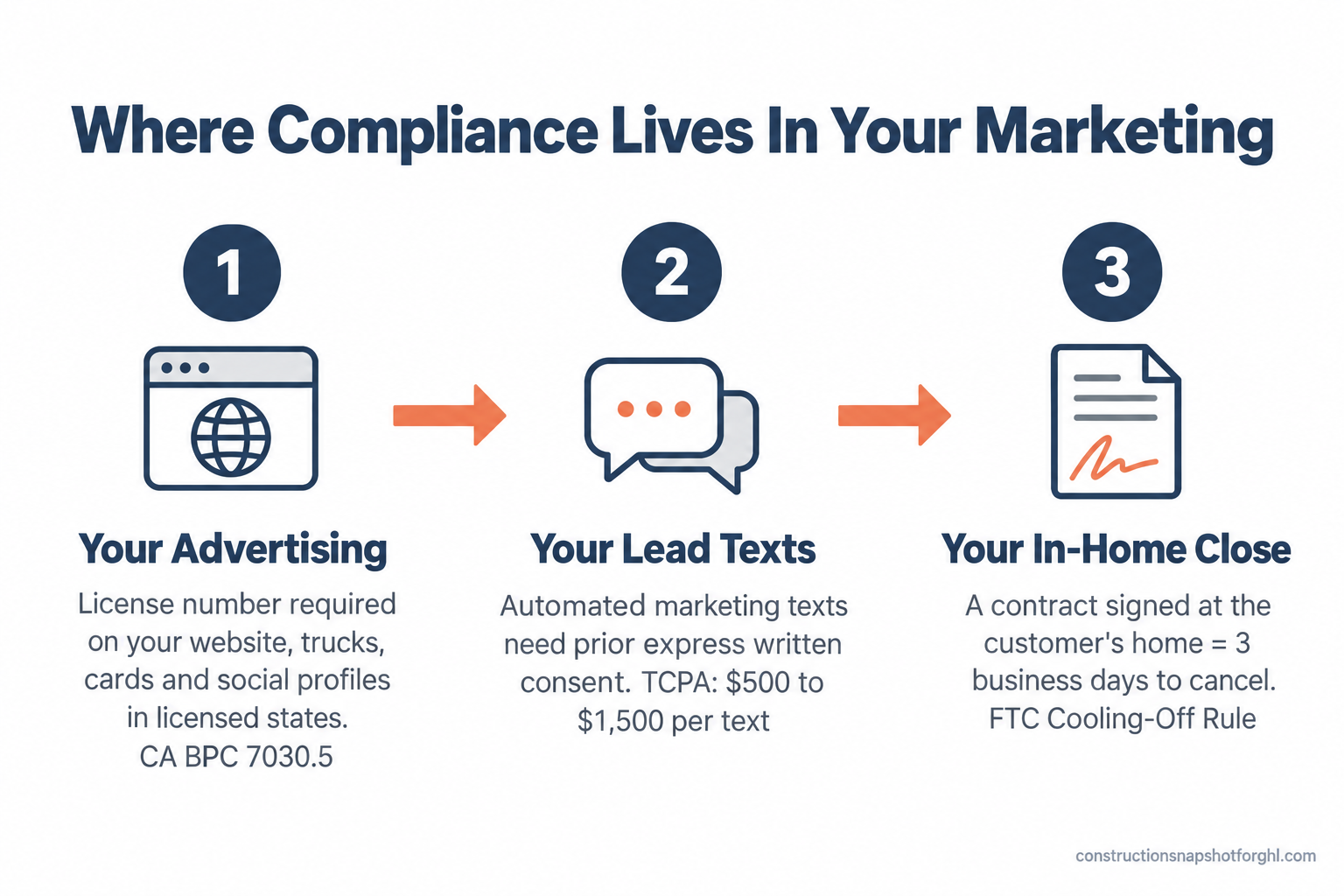
None of this is exotic. It is the plumbing of running a licensed trade. But because it lives in three different rulebooks (your state board, the FTC, and the FCC), most builders never see it in one place, and they find out a rule exists the day it costs them.
Do you even need a license, and the number that goes on everything
Start with the question underneath the advertising rule: does your state license contractors at all, and at what job size? Because if it does, the license number rule almost certainly applies to your ads, and if it does not, you have a different set of local rules to worry about.
The states pull in opposite directions. California is the strict end. As of the start of 2025, a license is required for any job where combined labor and materials top $1,000, up from the $500 line that had stood for decades (AB 2622, amending BPC 7048). Below that you can work unlicensed, but only if the job needs no permit and you hire no help. Cross $1,000, pull a permit, or bring on a helper, and you need it. Once you hold the license, BPC 7030.5 requires your number in all contracts, subcontracts and calls for bid, and all forms of advertising. The Contractors State License Board runs undercover stings on illegal ads, and administrative penalties for licensees can reach up to $5,000 per violation (BPC 7099.2).
Texas is the opposite pole: no state general contractor license at all. Regulation drops to the city, so Dallas, which requires registration and $300,000 of general liability insurance, is a different checklist from Houston, which asks for no GC registration and only licenses the trades. Those trades, electrical and HVAC and plumbing, are licensed statewide through the Texas Department of Licensing and Regulation and the plumbing board, so a Texas GC still cannot let an unlicensed electrician run wire. If you build in Texas, your homework is your city’s registration page, not a state website.
That spread is the whole point: a national “contractor advertising rules” checklist copied off the internet is wrong for you unless it names your state. Here is the shape of it for the states where the most remodeling work happens.
What licensing and advertising rules bite, by state (illustrative, confirm locally)
| Feature | License needed to work? | The rule that touches your marketing |
|---|---|---|
| California | Yes, above $1,000 in labor + materials | License number required on all advertising, website and trucks included (BPC 7030.5) |
| Texas | No state GC license; city registration varies | Trade licenses statewide; check your city's registration and insurance rules |
| Arizona | Yes, licensed by the Registrar of Contractors | License number on advertising; 20-day preliminary lien notice to keep lien rights |
| Florida | Yes, certified or registered contractor | License number required in any advertising medium (FL Statute 489.119) |
| Most licensed states | Usually above a dollar or permit threshold | Some form of license-number-in-advertising disclosure; confirm the exact wording |
Why do California, Texas, and Florida keep showing up? Because that is where the work is. NAHB counts about 128,000 remodeling firms in the country as of the start of 2025, more than double the 69,000 in 2000, and three states drive over a fifth of all remodeling activity: California at roughly $22.2 billion, Texas at $20.2 billion, and Florida at $15.4 billion (NAHB, August 2026). The states with the most builders also tend to have the most developed rulebooks, so the odds that a real rule applies to you go up with the size of your market.
Remodeling market size by state, US dollars in billions, 2026. These three states account for more than 20% of US remodeling activity. Source: NAHB State Projections of Remodeling, August 2026.
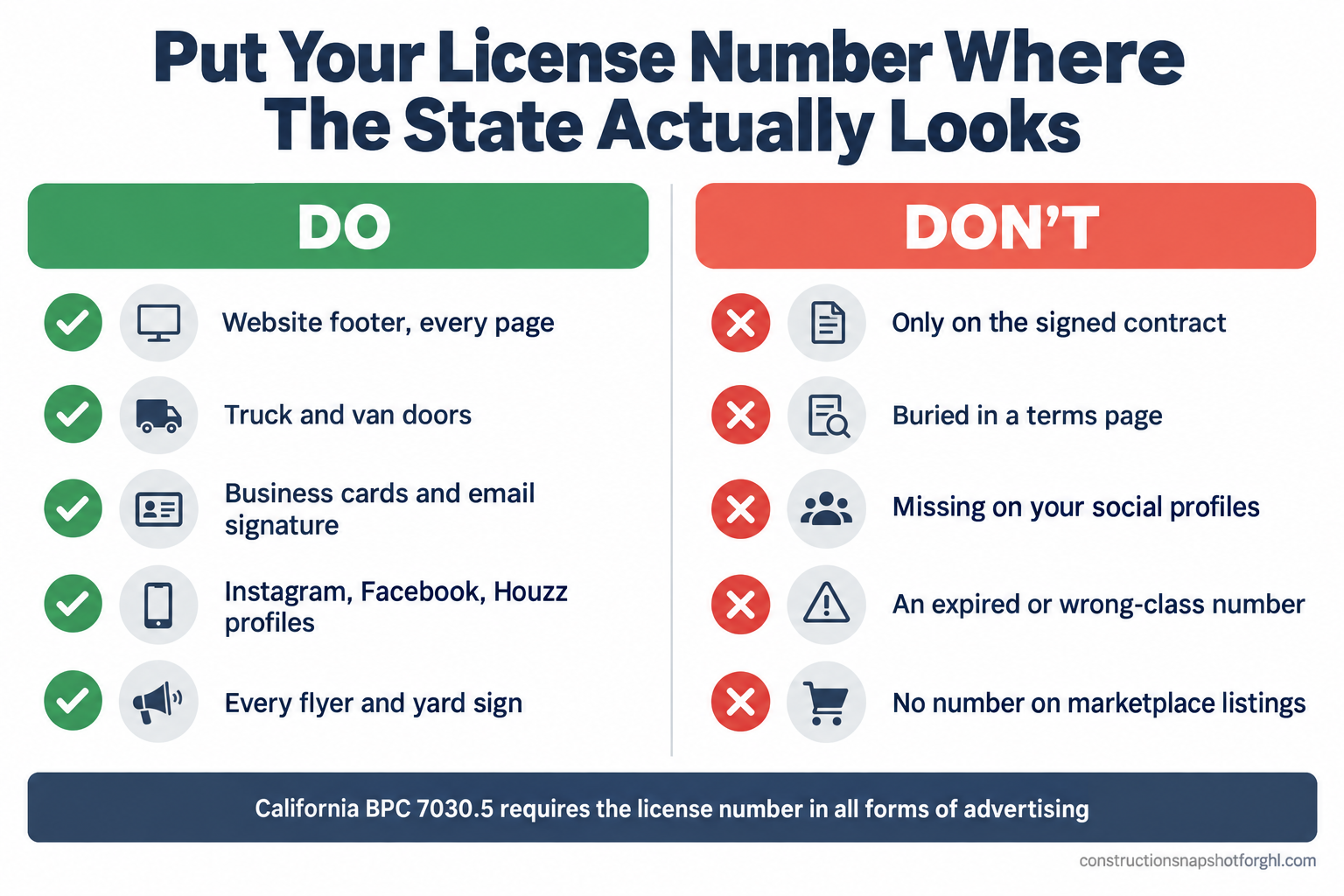
How this breaks. The failure is almost never a builder who refuses to comply. It is a builder who complied once, on the contract, and never carried it across to the marketing. The number is on the paperwork the client signs, but not on the website they found you through, the truck at the jobsite, or the Instagram profile where they first saw your work. In California those are three separate advertising surfaces, each missing the required number, and any of them can draw a citation. The second failure is the stale number: you let the license lapse or advertise a classification you do not actually hold, which is worse than a missing number because now the ad is false. Fix the first by making the license number a permanent element of every template. Fix the second with a renewal reminder in the same calendar you use for insurance.
Steal this: the compliant lines for your site, truck, and cards
You do not need a lawyer to write these. You need to put the same information in the same place on every surface. Here is the copy, ready to adapt with your own number and state.
The website matters most because it is the surface you fully control, and the one most likely to be missing the number because a template was built by someone who did not know the rule. A fully managed contractor website that keeps your license number, allowances, and pages current is the cheapest insurance against the dumbest citation in this whole post.
The texts you send leads: what the TCPA actually requires
The second place compliance lives is the one builders least expect, because it does not feel like advertising: the automated text your system sends. The missed-call auto-reply, the three-message estimate follow-up, the review request, the “we have an opening Thursday” nudge. Those are the workflows that win jobs, and the moment they fire automatically to a marketing list, the Telephone Consumer Protection Act is in the room.
The rule in plain terms: to send a marketing text through an automated system, you need the recipient’s prior express written consent before the first message. That means a documented opt-in: a checkbox they ticked on your web form, a signed line on your agreement, or a keyword they texted you first. A number you scraped off a Houzz lead or typed from a business card is not consent. And consent is specific to marketing: a customer who gave you their number to coordinate a build agreed to job texts, not to your monthly promotion, so get the marketing opt-in explicitly.
There was a real scare on this in late 2024. The FCC had adopted a stricter “one-to-one consent” rule that would have made lead-generation consent far narrower. The Eleventh Circuit vacated it on January 24, 2025, the day before it took effect, and the FCC did not fight it (Wiley, 2025). So “the one-to-one rule is dead” is true. The mistake is reading that as “texting rules got relaxed.” They did not. The underlying requirement for prior express written consent is untouched, and the TCPA still carries damages of $500 per text, tripled to $1,500 if the violation is willful (FCC, 47 U.S.C. 227). Those numbers are per message, and plaintiff’s lawyers run them as class actions.
TCPA statutory damages per unlawful text message, in US dollars. Willful or knowing violations can be trebled by a court. These are per-message and frequently pursued as class actions. Source: FCC / TCPA, 47 U.S.C. 227.
On top of the consent law is a carrier-level gate that is easy to confuse with it. To send business texts from a normal 10-digit number, you have to register your brand and campaign through the A2P 10DLC system with The Campaign Registry, or carriers throttle and block your messages. That is a deliverability requirement, not a legal one, but you need both: registration to get delivered, and consent to send lawfully. Our SMS system for contractors and the missed-call text-back workflow capture and log the opt-in at the form, which is the part that matters when someone asks you to prove consent.
How this breaks. The common failure is bulk-texting an old lead list. You export two years of Houzz and Angi contacts, load them into a new system, and blast a “we have winter openings” promotion. None of those people gave written marketing consent, and one annoyed recipient with a screenshot is a demand letter. The other failure is the reactivation campaign that treats an old customer like a fresh opt-in. Someone you built a deck for in 2022 is a warm lead, but the number they gave you to schedule the deck is not consent to a 2026 marketing text. Re-earn the opt-in before you automate to them.
The estimate you sign at the kitchen table: the three-day rule
The third place compliance lives is the moment you actually close. You walk the project, you build the number, and the homeowner says yes at their kitchen table and signs. That in-home signature triggers a federal rule most builders have heard of and few apply correctly: the FTC Cooling-Off Rule.
Here is what it says. For a sale of $25 or more made at the buyer’s home (the threshold is $130 at a temporary location like a home show or a hotel meeting room), the buyer has until midnight of the third business day to cancel, for any reason, and get their money back. And the seller has to give them, at the time of sale, a dated receipt and two copies of a Notice of Cancellation that spells out the right and the deadline (16 CFR 429.1). Those dollar thresholds were set by the FTC’s 2015 amendment, not any recent change, so do not let anyone tell you this is a new 2026 rule. It has been on the books for decades.
The part that trips builders up is what happens when you skip the notice. If you never give it, the three-day clock never starts, and the buyer’s right to cancel stays open, in some readings indefinitely, until you do provide it. So the contractor who skips the form to avoid the hassle has actually created an open-ended cancellation right, which is far worse than a defined 72-hour window. The rule is on your side when you follow it: the window is short, most homeowners who get cold feet do it in the first day anyway, and a clean cancellation form makes you the professional in a field full of handshake operators.
Note the boundary. The rule targets sales solicited at the buyer’s home. A contract negotiated and signed at your office, or one the customer invited you to their home to sign for a pre-agreed job, can fall outside it. Because the exemptions have real edges, the safe rule for a builder who closes at kitchen tables is simple: give the notice on every in-home signing. It costs nothing when nobody cancels and protects you completely when the edge cases show up.
The purely local one: lien preliminary-notice deadlines
One more rule is worth a short section because it is the most locally specific of all, and getting it wrong quietly forfeits your best collection tool. Several states make you serve a preliminary notice within a set number of days of first furnishing labor or materials, or you lose the right to file a mechanic’s lien later.
California and Arizona both run a 20-day clock. In California, a preliminary notice must be given no later than 20 days after you first furnish work on the improvement, or your lien rights only reach back 20 days before you eventually serve it (Civil Code 8204). Arizona’s preliminary twenty-day notice works the same way under ARS 33-992.01. Other states require no such notice at all. This is why a national “protect your lien rights” template is dangerous: it is either wrong or incomplete unless it names your state’s clock. If you build in a 20-day state, the fix is to make preliminary notice an automatic step that fires when a job starts, the same way your draw schedule fires at each milestone, not a thing you remember to do when a client goes quiet on payment.
Run it three ways: solo, mid-size, and multi-state
The same three rules land differently depending on how big you are and how many state lines you cross. Here is how I would prioritize the work at each size.
The solo operator or small remodeler (one state, 6 to 12 jobs). Your exposure is concentrated and cheap to close. Put your license number in the website footer, on the truck, and in your email signature this week. Add the consent checkbox to your one web form and the STOP language to your missed-call text. Attach the cancellation notice to every in-home contract. That is the whole list, and it is a single afternoon plus a template change. You are not running big lists, so your TCPA exposure is mostly the missed-call text and any manual blasts, both covered by the opt-in checkbox. The failure at your size is not doing the five basic things, not doing them imperfectly.
The mid-size design-build or remodeling firm (one to two states, 15 to 25 jobs). Now you have volume in your CRM, which makes the TCPA your biggest real risk. You are running follow-up sequences, review requests, and reactivation campaigns to hundreds of contacts. Audit where every number came from and whether you can prove marketing consent. Segment the list: contacts with a logged opt-in go into automation, everyone else re-consents before you market to them. Keep the advertising and cooling-off basics, and add a quarterly check that your license and insurance have not lapsed, because your advertised classification now has to match your active license across a bigger web footprint.
The larger GC or multi-state builder (two or more states, 30 to 40 jobs). Your problem is that the rules conflict across your footprint, so a single template is wrong somewhere. Your website footer needs the correct license number for each state, not one that is only valid at home. Your consent records need to be centralized and timestamped, because your text volume makes you a class-action-sized target. Your lien-notice process has to be state-aware, firing a 20-day preliminary notice on California and Arizona jobs and skipping it elsewhere. At this size the fix is systems, not memory: build the compliance elements into the workflows so the right rule fires per state, because no office manager holds four states’ rulebooks in their head across forty jobs.
The objections I hear
“I’ve advertised for ten years without my license number and never been fined.” Probably true, and that is survivorship talking. The rule is complaint-driven and sting-driven, so most violations are never caught, which makes the ones that are feel random. The cost of compliance is a footer line and a truck decal. The cost of the citation is a fine, an afternoon dealing with it, and a bad look if a client sees it. When the fix is that cheap, “I got away with it so far” is not a reason to keep the risk.
“Nobody actually sues a small contractor over a text.” They sue over lists, not single texts. A one-off text to one customer is not where TCPA cases come from. A promotional blast to a few hundred non-consenting numbers is, because it turns one annoyed person into a class representative with $500 to $1,500 per message to multiply. The opt-in checkbox is not there to protect you from your best customer. It is there so that when you run a campaign, you can prove the list was clean.
“Cooling-off means clients can back out of jobs I already sold. Why would I hand them the escape hatch?” Because skipping the notice does not remove the right, it removes the deadline. The three-day window is short and self-limiting, and the buyer who is going to get cold feet usually does it in the first 24 hours whether you gave them a form or not. What the form actually does is start and end the clock, so that on day four the deal is locked. Skip it and you leave the cancellation right open with no expiration, which is the opposite of what you wanted.
“I already pay for Buildertrend, isn’t compliance the software’s job?” No. Project-management software runs the job after it is sold. It does not put your license number on your marketing website, it does not capture text consent on your lead forms, and it does not generate your in-home cancellation notice. Those live in your marketing site and your CRM, which is a different tool doing a different job. Assuming your build software covers your advertising compliance is how the gap stays open. If you want to see what those platforms do and do not cover before you renew, we broke down what construction software actually costs and where the coverage stops.
Frequently asked questions
Does my contractor license number really have to be on my website?
In states that license contractors and have a license-number-in-advertising rule, yes. California's BPC 7030.5 requires the number in all forms of advertising, and the Contractors State License Board treats your website, social profiles, trucks, and business cards as advertising. Put the number in your website footer on every page, on your vehicles, and in your profile bios, and confirm your own state's exact wording, because the format and covered surfaces vary.
Do I need a license for small jobs?
It depends on your state's threshold. California raised its cap at the start of 2025: work over $1,000 in combined labor and materials requires a license, as does any job that needs a permit or where you hire help, regardless of price. Texas has no state general contractor license at all, though cities may require registration and the electrical, plumbing, and HVAC trades are licensed statewide. Check your state board for the number that applies to you.
Can I text my leads and past customers legally?
You can, with prior express written consent for marketing messages: a checkbox they ticked on your form, a signed line on your agreement, or a keyword they texted you first. Job-coordination texts to a customer who gave you their number for that purpose are lower risk, but a promotional blast to a list without logged consent exposes you to TCPA damages of $500 to $1,500 per message. Capture and timestamp the opt-in, and re-consent old lists before you market to them.
Is the FCC one-to-one consent rule still in effect in 2026?
No. The Eleventh Circuit vacated it on January 24, 2025, the day before it would have taken effect, and the FCC did not appeal. But that ruling only removed the stricter, narrower rule. The underlying TCPA requirement for prior express written consent to send marketing texts is unchanged, so you still need a documented opt-in before you automate to a marketing list.
What is the three-day right to cancel, and does it apply to me?
The FTC Cooling-Off Rule gives a buyer three business days to cancel a sale of $25 or more made at their home (or $130 or more at a temporary location like a home show). If you sign contracts at the customer's kitchen table it generally applies, and you must give a dated receipt and two copies of a Notice of Cancellation at signing. If you never give the notice, the cancellation right does not expire, so attaching it to every in-home contract protects you by starting and ending the clock.
What is a preliminary lien notice and when is it due?
In several states you must serve a preliminary notice within a set window of first furnishing labor or materials to preserve your right to file a mechanic's lien later. California and Arizona both use a 20-day deadline; miss it and your lien rights shrink or disappear. Other states require none. Because the rule is entirely state-specific, build it into your job-start checklist for the states that require it rather than trusting a national template.
Sources
- California Business and Professions Code 7030.5 (license number in advertising and contracts)
- California Business and Professions Code 7048 (the $1,000 unlicensed-work threshold)
- California Business and Professions Code 7099.2 (administrative penalties up to $5,000)
- FTC Cooling-Off Rule, 16 CFR 429.1 (three-day right to cancel and notice requirement)
- FTC 2015 final rule setting the $25 / $130 thresholds
- Eleventh Circuit vacates the FCC one-to-one TCPA consent rule, January 2025 (Wiley)
- FCC: Telemarketing, robocalls, and the TCPA
- Texas Department of Licensing and Regulation (trade licensing; no state GC license)
- California Civil Code 8204 (20-day preliminary notice)
- Arizona Revised Statutes 33-992.01 (preliminary twenty-day notice)
- NAHB: Three states drive over 20% of remodeling activity (August 2026)