
It is the Thursday of framing week and you are writing checks. The framing crew wants their draw, the lumber invoice is due, and the truss company will not schedule delivery until the deposit clears. You add it up in the truck and it is north of $40,000 going out this week. The money coming in? Your last draw request went to the homeowner nine days ago and it is still sitting there. So you cover it. Again. You are not building this house for the client anymore, you are lending them the money to build it and hoping they pay you back on their timeline.
Here is the short version. A draw schedule is the payment plan written into your contract that says exactly how much you get paid and at which point in the build. Done right, it keeps the money you have collected slightly ahead of the money you have spent, so you never front more than a few thousand dollars of your own cash. Done wrong, or left vague, you become the bank. The fix is a phase-by-phase schedule tied to real milestones a homeowner or lender inspector can see: a capped deposit, then a draw released at foundation, framing, rough-in, drywall, finishes, and completion, each one sized to the work in front of it. This post gives you the template, the percentage split for each phase, the exact wording to request a draw, and the payment rules that are law in some states so you do not accidentally write an illegal one.
In this post
- What a draw schedule actually is
- Why a vague schedule turns you into the bank
- The phase-by-phase draw schedule template
- The cash gap, drawn out
- Steal this: the draw request wording
- Run it three ways: solo, mid-size, and large
- The payment rules that are actually law
- Common objections
- Frequently asked questions
- Sources
What a draw schedule actually is
A draw schedule is the section of your contract that breaks the total price into payments and ties each payment to a point in the build. Instead of “pay me $280,000 for the addition,” it says “pay $28,000 at signing, $42,000 when the foundation is poured and passes inspection, $70,000 when framing is complete and the building is in the dry,” and so on to the final payment at punch-list.
People mix up two terms here, so let me separate them. A draw schedule is milestone-based: money releases when a phase of work is finished. Progress billing is the broader practice of billing for work as it gets done, often monthly, against a schedule of values. For a custom home or a big remodel funded by a construction loan, the lender runs on a draw schedule and sends an inspector to verify the milestone before releasing funds. For a cash-paying homeowner on a $60,000 kitchen, you are the one setting the draws. Either way, the principle is identical: you get paid for a chunk of work when that chunk is visibly done.
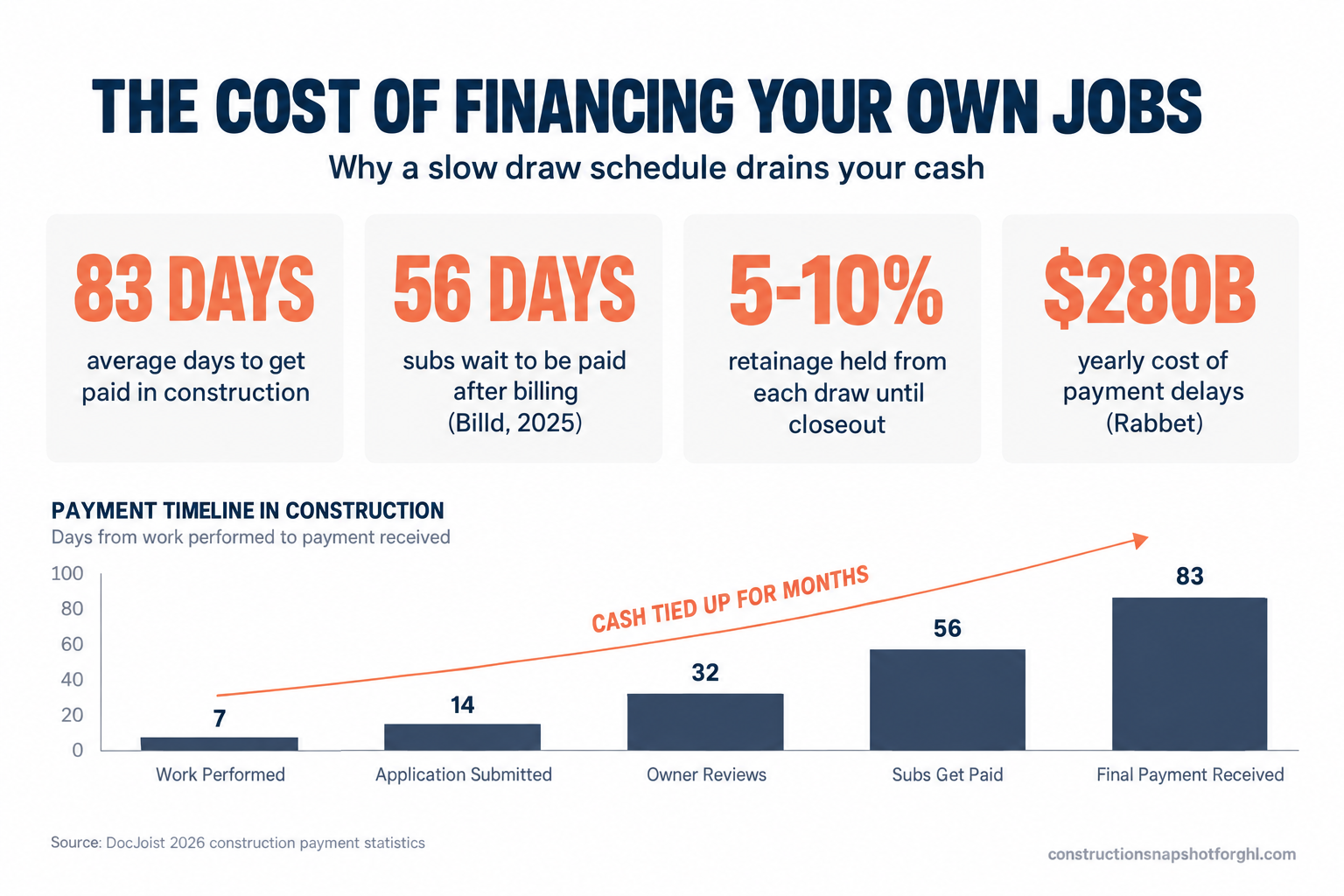
The reason this matters more than almost any other document you sign is timing. Construction spends money before it collects it. You buy materials, you pay subs, you cover labor, and only later do you bill for it and wait to get paid. That lag is brutal in this trade. Construction carries roughly 83 days of average days sales outstanding, among the highest of any major industry, and subcontractors wait an average of 56 days to get paid after they bill, according to Billd’s 2025 State of Subcontractor Payments (DocJoist, 2026). A draw schedule is the one tool that lets you shrink that gap on purpose instead of absorbing it.
Why a vague schedule turns you into the bank
Here is what a weak draw schedule looks like, and it is more common than it should be: a big deposit, a fuzzy “progress payments as needed” middle, and a balance at the end. It feels flexible. It is a trap.
The problem is that “as needed” has no trigger, so every draw request becomes a negotiation. The homeowner is nervous about the budget, does not see an obvious milestone, and asks you to wait until “more is done.” Meanwhile you have already paid the framer and the lumberyard. Multiply that across a few overlapping jobs and you are floating tens of thousands of dollars of other people’s construction on your own line of credit. Payment delays now drive up costs across the industry by an estimated $280 billion a year, according to Rabbet’s Construction Payments Report (DocJoist, 2026), and a big slice of that is contractors financing work they already performed.
The other failure is a schedule that is front-loaded past what the work justifies. Some builders try to fix cash flow by taking a huge deposit and a fat second draw. It backfires two ways. First, in several states it is flat-out illegal, which we will get to. Second, it destroys homeowner trust. A client who has paid you 60 percent when the house is 30 percent built starts watching you like a hawk, slows down every future approval, and tells their neighbor you took the money and disappeared. You want the money slightly ahead of the work, not wildly ahead of it. A little ahead protects you. A lot ahead makes you the villain in a story you did not mean to write.
The version that works is boring and specific: named milestones, a percentage tied to the cost of that phase, and a request that goes out the day the milestone is hit. Boring is what keeps you solvent.
The phase-by-phase draw schedule template
Below is a representative residential draw schedule for a build or a gut remodel, sized so each draw roughly matches the money that leaves your account during that phase. Treat the percentages as a starting point. Your lender, your contract, and your actual cost breakdown set the final split, and framing-heavy or finish-heavy jobs will shift the weights. What matters is the logic: each draw covers the phase it is attached to, and the trigger is something a person can stand in the house and verify.
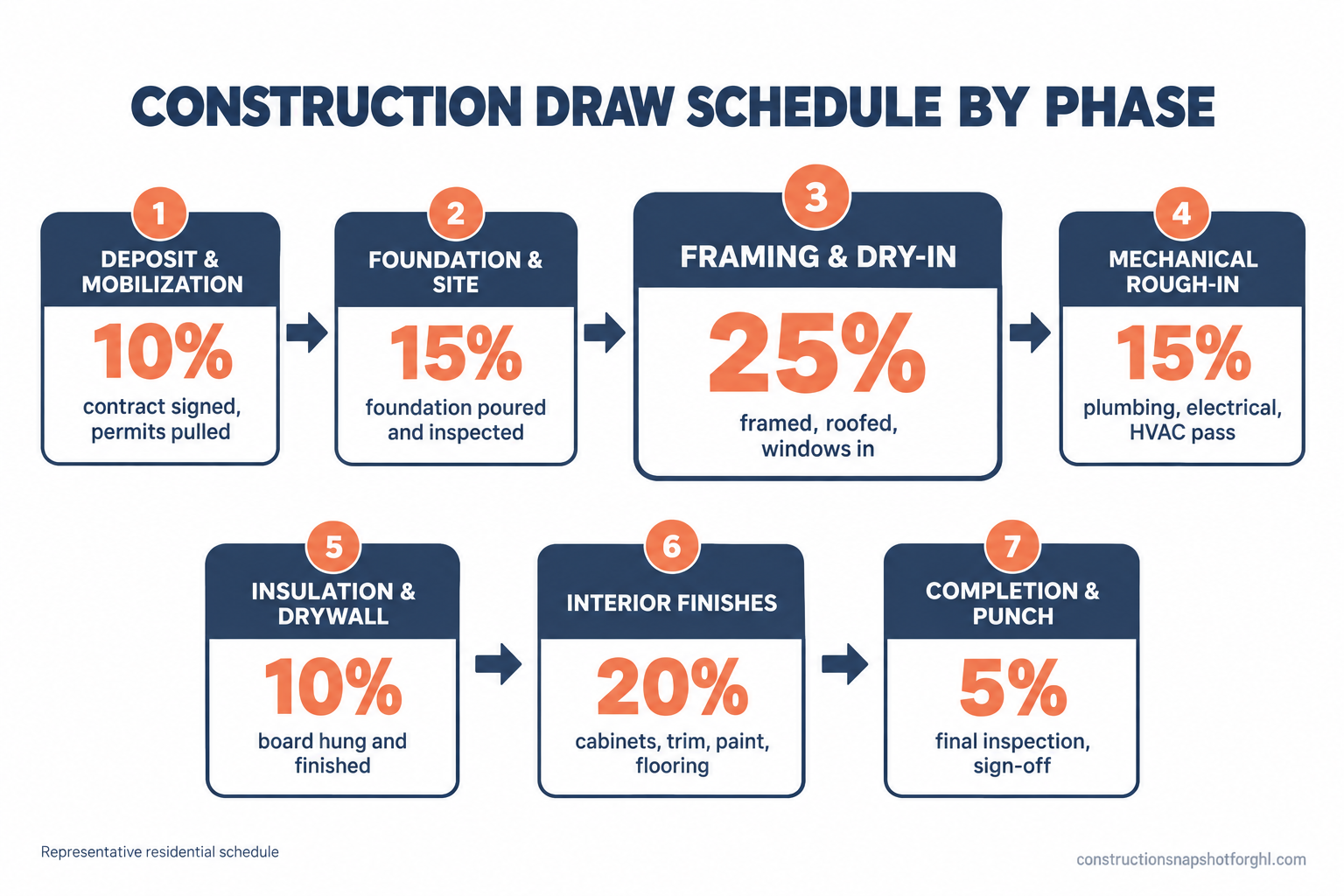
Representative residential draw schedule
| Feature | % of contract | Released when (the trigger) |
|---|---|---|
| 1. Deposit & mobilization | 10% | Contract signed; permits pulled, job scheduled |
| 2. Foundation & site work | 15% | Excavation done, foundation poured and inspection passed |
| 3. Framing & dry-in | 25% | Framed, roofed, windows and exterior doors set (in the dry) |
| 4. Mechanical rough-in | 15% | Plumbing, electrical and HVAC rough-in passes inspection |
| 5. Insulation & drywall | 10% | Insulation in, board hung, taped and finished |
| 6. Interior finishes | 20% | Cabinets, trim, paint and flooring installed |
| 7. Completion & punch | 5% | Final inspection, punch-list complete, certificate issued |
Draw 1, deposit and mobilization (10 percent). This covers getting started: permits, deposits to lock in your framing and truss suppliers, and scheduling. Keep it modest. A 10 percent deposit reads as fair to a homeowner and, in some states, 10 percent is the legal ceiling. Where it breaks: builders who take a 30 or 40 percent deposit to fund another job’s shortfall. You are borrowing from this client to pay for a different client’s mistake, and it catches up with you the first time a job stalls.
Draw 2, foundation and site work (15 percent). Excavation, footings, the slab or foundation walls, and the inspection that signs off on it. This is the first draw tied to a hard, visible milestone, and a passed foundation inspection is about the cleanest trigger there is. Where it breaks: weather and change orders. If the client adds a basement or you hit rock, that scope was not in the 15 percent. Price the change order and collect it before you keep pouring, or this draw silently goes underwater.
Draw 3, framing and dry-in (25 percent). The biggest single draw, because framing is where the most money leaves your account at once: the lumber package, the framing crew, the roof, windows and exterior doors. Structural framing is usually the largest phase of a residential budget, often 25 to 30 percent, released when the building is “in the dry” (Corpay, 2026). Where it breaks: the lumber invoice comes due before the framing is finished enough to trigger the draw. This is the single most common cash squeeze in a build. The fix is to split it: a partial draw when the deck and walls are up, the balance at dry-in.
Draw 4, mechanical rough-in (15 percent). Plumbing, electrical and HVAC roughed in behind the walls, released when the rough inspection passes. Clean trigger, and it keeps your trade partners paid on time so they show up for your next job. Where it breaks: inspection delays. If the inspector is booked two weeks out, you have paid the subs and cannot trigger the draw. Bill the completed rough-in on your own certification with photos where your contract and lender allow it, so you are not held hostage by the inspection calendar.
Draw 5, insulation and drywall (10 percent). Insulation in, board hung, taped, mudded and sanded. A satisfying milestone because the house suddenly looks like a house, which also makes it an easy draw to collect. Where it breaks: the client wants to “wait and see the paint” before releasing. Drywall complete is the trigger, not the client’s mood. Put the trigger in writing so there is nothing to debate.
Draw 6, interior finishes (20 percent). Cabinets, countertops, trim, interior doors, paint and flooring. The second-biggest draw, because finishes are expensive and selection-driven. Where it breaks: stalled selections. If the homeowner has not picked tile, this phase drags for weeks while your finish carpenter sits idle and your schedule slips. A selections process that does not stall the build is what protects this draw.
Draw 7, completion and punch (5 percent). The final payment, released at final inspection and punch-list sign-off. Keeping it at 5 percent is deliberate: it is small enough that the client is not tempted to weaponize it, but real enough to motivate you to finish the punch-list fast. Where it breaks: the endless punch-list. A homeowner holding your final 5 percent can nickel-and-dime you for a month. Define “substantial completion” in the contract and cap the punch-list window so the final draw has a deadline too.
The cash gap, drawn out
Look at the same schedule as a running total and the point of the whole exercise jumps out. The line below is the cumulative percentage of the contract you have collected by the end of each phase. Notice how flat it stays through the early, expensive work: by the time framing is done, you have collected half the contract, but framing plus foundation is where a huge share of your hard cost already went out the door.
Cumulative percentage of contract value collected by the end of each phase, using the representative schedule above. Illustrative; your split will differ. The gap between this line and your cumulative spend is the cash you are floating, which is why draw timing and same-day billing matter so much.
That gap between what you have collected and what you have spent is the money you are financing. Your only levers to shrink it are three: size each draw to its phase, trigger it on a milestone nobody can argue with, and bill the day the milestone hits. Miss the third and the first two do not save you. This is exactly the leak that quietly shows up as profit that disappeared on your last job, even when the estimate looked fine on paper.
Steal this: the draw request wording
The schedule is only half of it. The other half is the request, and the request has to be fast, specific, and impossible to misread. Here is the language, ready to send.
Send these by hand and they work. Send them late and they do not. The single biggest change most builders can make is not the schedule itself, it is closing the lag between “milestone hit” and “request sent” to zero, so the invoice and photos go out automatically the moment a phase is marked done. That is a systems problem, the same one that quietly kills estimate follow-up, and it is the one worth solving.
Run it three ways: solo, mid-size, and large
The right schedule depends on your size and how your jobs are funded, because the cash-flow math is very different at each scale.
The solo operator or small remodeler (6 to 12 jobs a year, cash-paying clients). Your jobs are smaller and almost always homeowner-funded, so you set the draws and you feel every dollar of float personally. Use more draws, not fewer. On a $60,000 kitchen, a 10 percent deposit and five smaller milestone draws keeps you within a few thousand dollars of even the whole way through. Keep the deposit legal and modest, and collect each draw same-day, because you do not have a line of credit deep enough to float a slow-paying client. At this size, tight draw discipline is the difference between making payroll and putting materials on a credit card.
The mid-size design-build or remodeling firm (15 to 25 jobs, mix of cash and financed). You are juggling several jobs at once, so a slow draw on one bleeds into your ability to start the next. Standardize the schedule across every contract so your office is not tracking seven different payment plans, and split your two big draws, framing and finishes, into partial releases so you are never waiting on one giant milestone. This is the tier where a consistent, automated request process pays for itself fastest, because the money leaking is not one job, it is a little bit on every job, every month.
The larger custom builder or production builder (30 to 40 jobs, mostly lender-financed). Now the lender’s draw schedule and inspection process often set the rhythm, and your job is to align your subs’ payment terms to it so you are not paying trades 30 days before the lender releases the matching draw. Negotiate the draw schedule with the lender up front, front-load nothing you cannot justify at inspection, and hold a small retainage back from your own subs that mirrors what the lender holds from you. At this scale the risk is not one client stiffing you, it is a structural mismatch between when you pay out and when you draw in, repeated across dozens of homes.
The payment rules that are actually law
A draw schedule is a legal document, and in several states the law sets hard limits on what you can put in it. Get this wrong and you are not just risking cash flow, you are risking your license. This is not legal advice, and the rules vary by state, so confirm yours before you finalize a contract template. Two rules bite the hardest.
Deposit and progress-payment caps. In California, a home-improvement contract may not take a down payment larger than $1,000 or 10 percent of the contract price, whichever is less, and every progress payment after that must not exceed the value of the work already performed and materials already delivered (California BPC 7159.5). That single rule makes a front-loaded schedule illegal in California: you cannot legally collect 40 percent when the job is 20 percent done. The contract even has to print the down-payment limit in boldface. Other states have their own versions, and some have none, so a national contract template will be wrong for someone unless you scope the deposit language to where you build.
Licensing details on the contract itself. In California your CSLB license number is required on your contracts and advertising (California BPC 7030.5), and note that the license threshold is changing: as of January 1, 2026, work of $1,000 or more requires a license, up from the old $500 line that many contractors still quote. Texas, by contrast, has no statewide general-contractor license and pushes registration down to the city, so the same contract needs different license language depending on the state. Bake the right deposit cap and license language into your template per state, so you are compliant by default instead of fixing it contract by contract.
The through-line: your draw schedule protects your cash, and the law decides how far you can push it. Build the schedule to stay slightly ahead of the work, which is exactly what a legal progress-payment structure allows anyway, and you get both at once.
Common objections
“My clients would balk at a rigid schedule.” They balk at surprises, not at structure. A clear draw schedule with visible milestones is the most reassuring thing you can hand a nervous homeowner, because it tells them precisely what they are paying for and when. The clients who fight a milestone schedule are usually the ones who were hoping to stretch you thin, and those are exactly the clients a schedule protects you from. Present it as protection for them too: they never pay ahead of the work.
“I already use Buildertrend or JobTread for invoicing, isn’t that handled?” Your project-management tool can store the schedule and send an invoice, but it does not make you hit send the moment a milestone passes, and it does not chase the homeowner the day a draw goes overdue. The leak is almost never the invoice template. It is the human lag between “foundation passed” and “request sent,” and the follow-up that never happens because you were on a jobsite. That gap is where the float lives.
“Isn’t a bigger deposit just simpler?” Simpler for one job, dangerous across many, and illegal in some states. A big deposit feels like breathing room, but it is borrowed breathing room: you have spent money you owe to the client as future work, and if that job stalls you are underwater on it and on whatever you spent the deposit on. A modest deposit plus disciplined, same-day draws gives you steadier cash with none of the legal exposure or trust damage.
“What about change orders, don’t they blow up the schedule?” They do if you let them ride. Every change order is a mini draw: it has its own scope, its own cost, and it should be priced and collected before the work happens, not bundled into the next milestone where it disappears. Unpriced changes are one of the biggest reasons a schedule that looked balanced ends the job underwater. Handle them as their own signed, paid step and your draw schedule stays intact.
Where to start this week
Pull your current standard contract and find the payment section. If it says anything like “progress payments as needed” or leans on one big deposit, that is your leak. Rewrite it as seven named milestones with a percentage and a trigger for each, using the template above as your starting point, then check your state’s deposit cap so the first line is legal. Then fix the part that actually costs you money: decide how the draw request gets sent the same day a phase is marked complete, every time, without you remembering. Nail those two things and you stop being the bank on your own jobs. That last piece, the automatic request and follow-up, is the part the Construction Snapshot for GoHighLevel builds, and you can hand the whole setup to a trained GHL VA if you would rather never touch it.
Frequently asked questions
What is a construction draw schedule?
A construction draw schedule is the part of your contract that splits the total price into payments and ties each payment to a milestone in the build. Instead of one lump sum, the client (or their lender) pays a set amount when the foundation is poured, when framing is complete, when rough-in passes inspection, and so on. Its purpose is cash flow: it keeps the money you have collected close to the money you have spent, so you are not financing the project out of your own pocket.
What percentage should each draw be?
A common residential split is roughly 10% deposit, 15% at foundation, 25% at framing and dry-in, 15% at mechanical rough-in, 10% at drywall, 20% at interior finishes, and 5% at completion. Framing is usually the largest single draw because that is where the most money leaves your account at once. Treat these as a starting point: your lender, contract, and actual cost breakdown set the final numbers, and a finish-heavy or framing-heavy job will shift the weights.
How many draws should a residential project have?
Most single-family construction loans use four to six draws keyed to major phases, and larger custom homes or gut remodels often use seven or more. If you are the one setting the schedule on a cash-funded job, more, smaller draws are generally safer than fewer big ones, because they keep your collected money closer to your spend at every point in the build.
What is the difference between a draw schedule and progress billing?
A draw schedule is milestone-based: money releases when a defined phase of work is finished and, on a financed job, verified by a lender's inspector. Progress billing is the broader practice of billing for work as it is completed, often monthly, against a schedule of values. On a custom home the lender runs a draw schedule; on a cash remodel you set the draws yourself. Both exist to get you paid for work as you do it rather than all at the end.
Is there a legal limit on how much deposit I can take?
In some states, yes. California caps a home-improvement down payment at $1,000 or 10 percent of the contract price, whichever is less, and requires every progress payment after that to not exceed the value of work already performed (Business and Professions Code 7159.5). Other states have their own limits and some have none. Because the rules vary and this is not legal advice, confirm your own state's deposit and progress-payment rules before finalizing a contract template.
Why do I keep having to pay subs before I get paid?
Because construction spends money before it collects it, and the lag is long: the industry averages around 83 days of days sales outstanding and subcontractors wait about 56 days to get paid after billing. A tight draw schedule shrinks that gap by sizing each draw to its phase and triggering it on a visible milestone, but only if you actually send the draw request the day the milestone is hit. The float lives in the delay between finishing the work and asking to be paid for it.
Sources
- DocJoist: Construction Payment Statistics 2026 (compiling Billd, CreditPulse, Rabbet data)
- Corpay: Construction Cash Flow
- California BPC 7159.5 (home-improvement down payment and progress-payment limits)
- California BPC 7030.5 (license number in advertising and contracts)
- NAHB: Three states drive over 20% of remodeling activity (Aug 2026)
- JCHS: Remodeling growth set to downshift in late 2026 (LIRA)