You saw the Houzz Pro ad in your feed somewhere between a kitchen remodel photo and a competitor’s finished deck. The pitch is clean: one tool that brings you homeowner leads and runs the job after you win it. You see “$199 a month” and think that is fair, because the framer in your group chat pays about that for JobTread. So you book the demo. Three weeks later your card gets hit for $698, and you are still not sure where the extra five hundred dollars went.
Here is the short version so you can decide before the demo call. Houzz Pro’s published software plans are Design at $99 a month and Pro at $199 a month, each including one user, with extra seats at $50 each per month (Houzz Pro). That $199 sticker matches JobTread, but two things change the real bill. First, the leads most contractors sign up for are not in that price. Advertising on the Houzz marketplace is a separate package starting at $499 a month (Houzz Pro). Second, at $50 per extra seat, a five-person office pays $399 a month for software alone, versus $279 on JobTread, which charges $20 a seat (Capterra). If you want the Houzz leads, Houzz Pro can be worth it. If you want project software, you are overpaying, and JobTread, Contractor Foreman, Knowify, or BuildBook all do the job management for less. Below is the real math, five alternatives on published pricing, and the one thing none of them fix.
In this post
- What Houzz Pro actually is
- What Houzz Pro really costs in 2026
- The eight things that matter to a small shop
- The five alternatives on one screen
- What you pay at 5 users
- Three shops, three right answers
- Where Houzz Pro quietly breaks for a builder
- The leads problem no project tool fixes
- Steal this before you book the demo
- Common objections
- Frequently asked questions
- Sources
What Houzz Pro actually is
Most tools on your shortlist started as software. Houzz Pro started as a website. Houzz.com is a home-design marketplace where homeowners browse photos and look for contractors, and that audience is the product. Houzz Pro is the paid account that lets a contractor show up in that marketplace, collect leads, and, more recently, manage the jobs with estimating, proposals, a client dashboard, and invoicing.
That history explains the pricing. When JobTread or Contractor Foreman says $199 or $49, that is the whole software. When Houzz Pro says $199, that is the software plus a spot in the marketplace, but the leads that make the marketplace worth anything are sold on top. You are renting a storefront in someone else’s mall, and the foot traffic costs extra. That does not make it a bad product. For a remodeler in a metro where homeowners use Houzz, the marketplace can be a real pipeline. The mistake is comparing its $199 against JobTread’s $199 as if they are the same thing.
What Houzz Pro really costs in 2026
Here is the honest breakdown, straight from the Houzz Pro pricing page (Houzz Pro). The software has three tiers: Design at $99 a month and Pro at $199, each including one user, and Teams from $399 with unlimited users, quoted through a demo. Every extra seat on Design or Pro is $50 a month.
Then there is the part that catches people. Lead advertising is a separate package starting at $499 a month, and that is the money that puts you in front of homeowners searching Houzz in your area. If leads are why you are looking at Houzz Pro at all, your real entry price is not $199. It is $199 plus $499, which is $698 a month before you add a single seat.
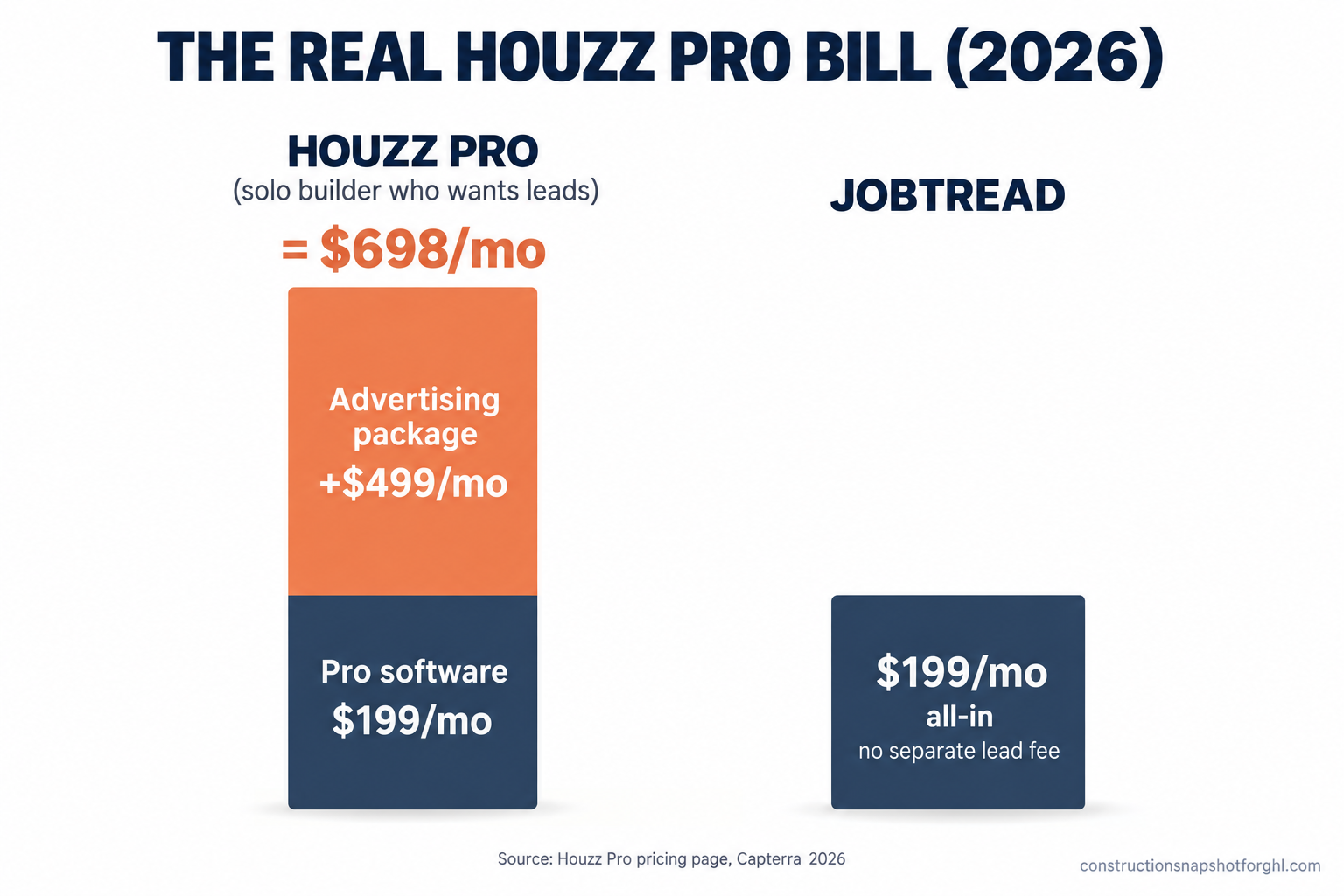
Compare that to the field. JobTread is $199 a month including your first user, extra seats at $20, no contract (Capterra). Contractor Foreman runs $49 to $332 a month, billed annually (Capterra). Knowify starts around $99 a month on annual billing, extra users about $10 each (Capterra). BuildBook starts at $79 and bundles unlimited users into each tier (Capterra). Every one of those is project software you can price in your head. Houzz Pro is the only one where the number on the ad is not the number on the invoice.
Published entry price, one user, dollars per month (2026). Houzz Pro’s $199 buys software only; the Houzz marketplace leads are a separate $499-a-month package. Source: Houzz Pro, Capterra.
The eight things that matter to a small shop
A demo shows you forty features. Eight decide whether the tool fits a 6-to-40-job builder.
1. Price transparency. Houzz Pro publishes its software tiers but gates the Teams plan and the lead package behind a demo, so your true cost needs a sales call. JobTread, Contractor Foreman, BuildBook, and Knowify all publish their numbers. That is the biggest reason the cheaper tools feel honest: you can shop them in a browser tab at 10pm.
2. What you really pay per user. The quiet margin killer. Houzz Pro charges $50 per extra seat. JobTread charges $20, Knowify about $10, and BuildBook and Contractor Foreman bundle users into tiers so your next hire does not move the bill until you cross one. At $50 a head, per-seat pricing becomes a different tool entirely by your fifth hire.
3. Leads: included or sold separately. Only Houzz Pro brings leads, and they cost $499 a month on top. The other four have no marketplace. That is the core decision, not a knock. Paying Houzz Pro for software alone means buying the one option here that costs more and bundles a marketplace you are not using.
4. Estimating and proposals. All five build estimates and send client-facing proposals. Houzz Pro leans on its design heritage with polished, visual proposals that genuinely help on a kitchen or bath sell. JobTread and Knowify are stronger on job costing, tying the estimate to a live budget. Match that to how you sell.
5. Change orders and client communication. Every one has change-order tools and a client portal. None of them make the homeowner actually sign before your crew does the work. The portal holds the document; getting it signed fast is a process problem, and the updates that keep a homeowner calm still have to be pushed by text, not left behind a login they forgot.
6. Setup and learning curve. The project-only tools tend to go live in days. Houzz Pro’s software is quick too, but the advertising package ramps slowly while the marketplace learns which leads to send you, and month one is often the weakest. A lead tool is not fully live the day you pay.
7. Contracts, lock-in, and data export. JobTread’s no-contract, month-to-month model is easiest to leave. Before you sign, ask how you export your clients, estimates, and photos, and whether there is a charge. On a marketplace, your reviews and profile history live on their platform, which is its own lock-in.
8. Who it is built for. Houzz Pro fits a design-driven remodeler in a Houzz-heavy metro who wants leads and polished proposals in one place. The others fit a builder who already has lead flow and needs the back office to stop leaking. Decide which you are and the choice gets easy.
The five alternatives on one screen
Houzz Pro vs the project-only field (small-builder view)
| Plan | JobTread recommended | Houzz Pro | Contractor Foreman | BuildBook | Knowify |
|---|---|---|---|---|---|
| Price | $199/mo | $99-$399/mo | $49-$332/mo | $79-$249/mo | ~$99/mo |
| Feature 1 | Price published, no contract | Design $99, Pro $199, Teams $399 | Price published, per-tier users | Price published, flat per tier | Price published, extra users ~$10 |
| Feature 2 | Extra seats $20/mo each | Extra seats $50/mo each | Lowest entry point on the list | Unlimited users in every plan | Strong job costing + QuickBooks |
| Feature 3 | All features on one plan | Leads sold separately, from $499/mo | Core PM, estimating, scheduling | Simple, communication-first UI | Good for trade + commercial work |
| Feature 4 | Strong job costing + client portal | Best-in-class visual proposals | Billed annually for best rate | Good fit for smaller remodelers | Billed annually for best rate |
| Feature 5 | Free subs, vendors, client access | Marketplace reach on Houzz.com | Lighter polish than JobTread | Lighter financials than rivals | Steeper learning curve |
| Feature 6 | No leads, project software only | Teams + ad pricing gated by demo | No leads, project software only | No leads, project software only | No leads, project software only |
What you pay at 5 users
Almost no builder stays at one user. Add an estimator, a PM, an admin, and a lead carpenter and you are at five seats fast. Here is where the per-seat math lands.
JobTread at five users is $199 plus four seats at $20, so $279 a month. Houzz Pro’s Pro plan is $199 plus four seats at $50, so $399 for the software alone, or $898 with the $499 lead package. Contractor Foreman’s Plus tier covers eight users at $166, BuildBook’s Team tier bundles unlimited users near $149, and Knowify’s core plan with four extra seats lands around $139 on annual billing. Same five people, and the spread runs from $139 to $399 before anyone buys a lead.
Estimated monthly software cost for 5 internal users, 2026 published rates. Houzz Pro adds $499/mo for the lead package on top of the $399 shown. Source: Houzz Pro, Capterra.
The gap is not small. Over a year, Houzz Pro’s software for five people runs about $4,800 versus roughly $3,350 on JobTread. That $1,450 buys you nothing extra unless you use the marketplace. For a shop doing 20 jobs at a 10 percent net, that is most of the margin on a decent change order.
Three shops, three right answers
The right tool changes with the shape of your business.
The solo or two-person shop, 6 to 12 jobs a year. You need estimates out fast and jobs that do not fall through the cracks, not a marketplace. BuildBook at $79 or Contractor Foreman at $49 is a real floor, both with published prices. Want more job-costing muscle, JobTread at $199 fits. Houzz Pro makes sense only if you have no lead source and the marketplace is strong in your city, and then you are buying it for the $499 leads.
The mid-size builder, 15 to 25 jobs, three to five in the office. This is where the per-seat gap bites. JobTread at roughly $279 for five seats, all features, no contract, is the default. Knowify is the pick for mixed residential and light-commercial work in QuickBooks. Houzz Pro earns its $399-plus only if the marketplace is a real slice of your pipeline.
The larger residential firm, 30 to 40 jobs, a real team. At ten users, Houzz Pro’s software alone is around $649 a month before leads. JobTread is about $379, and Contractor Foreman’s Pro tier covers 15 users at $221. At this size the per-seat penalty is the whole argument against Houzz Pro for software, and the only reason to carry it is a marketplace pipeline you have measured in signed dollars and trust.
Where Houzz Pro quietly breaks for a builder
Every tool has a seam where it fails a small shop. Knowing Houzz Pro’s ahead of time beats any feature list.
The leads are shared, not yours. A Houzz lead is rarely sent to you alone. The homeowner is browsing and often contacting several pros at once, so you are in a race from the second it lands, and Houzz leads go cold fast. If your intake is a human checking email between site visits, you lose to whoever texts back first. The tool creates the lead; it does not win it.
The marketplace ramp is slow and lumpy. The ad package does not deliver a steady stream on day one. Early leads skew low-intent while the system learns your area. Builders judge it on month one and cancel right before it would have worked, or keep paying for weak leads out of inertia. Set a measurement window up front, in signed revenue, not lead count.
Per-seat pricing punishes growth. The moment you hire, the bill jumps $50 a head. A tool that gets more expensive exactly as you scale is working against the plan. The options that bundle users, or charge $20 a seat, do not tax your next hire the same way.
Your reviews live on their platform. The reputation you build inside the Houzz marketplace is an asset on Houzz, not something you own. Leave, and the profile history and review volume that took years to build mostly stay behind. That switching cost never shows up on the pricing page.
The leads problem no project tool fixes
Here is the part no demo will put in front of you. Every tool on this list does its job after a lead has already decided to talk to you. The leak that costs a small builder the most money happens before that.
The Houzz lead that sat in an inbox for four hours and went to the contractor who replied in four minutes. The missed call at 7:40am while you were up a ladder that rang the next number on the list. The estimate you sent and never followed up on, which is a big part of why you bid more and close less. Houzz Pro will send you more leads. It will not answer the phone, text back in 60 seconds, or chase a quiet estimate. That is a front-end sales and CRM job, a different category of software than any project tool here.
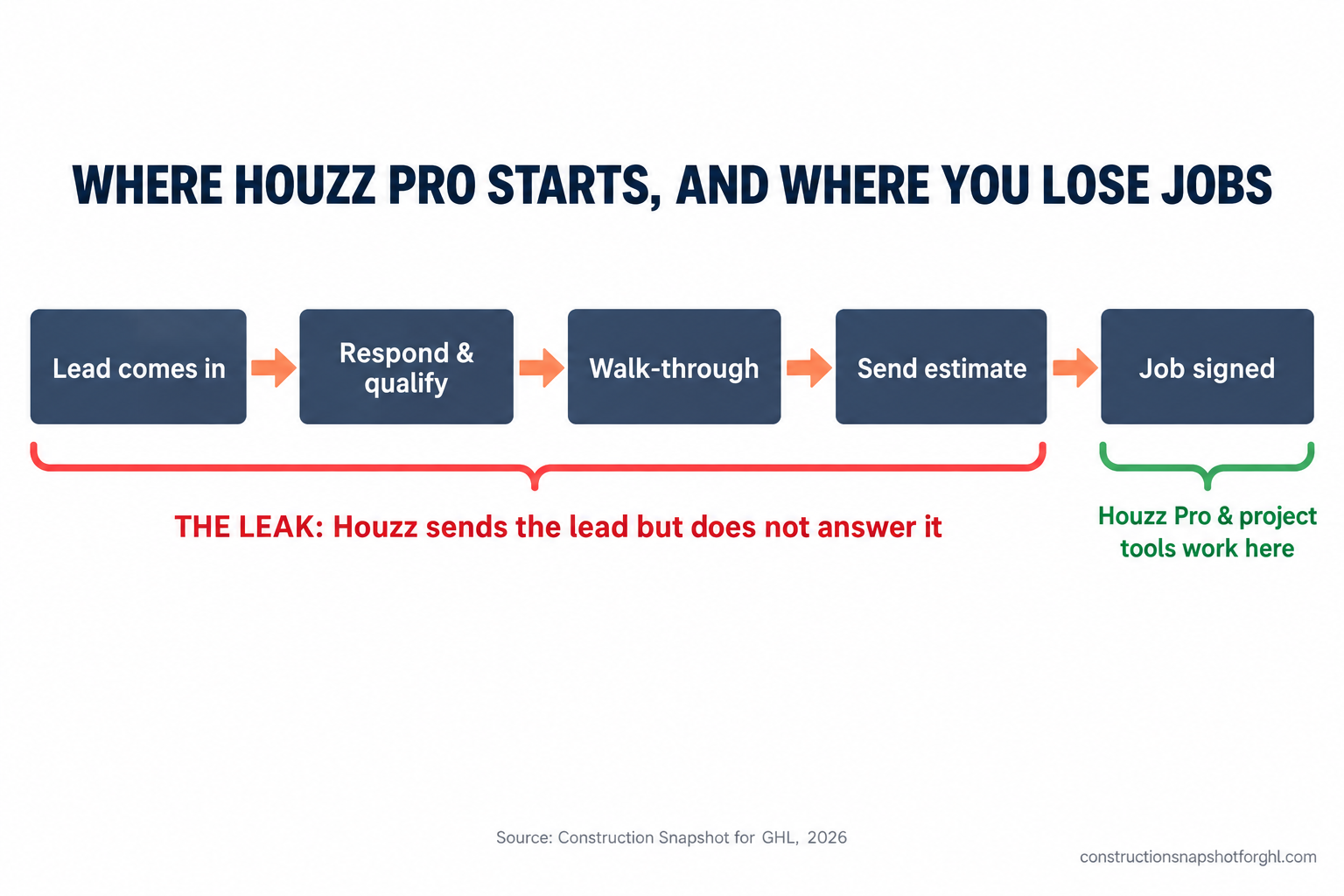
This is why Houzz Pro disappoints builders who expected it to grow the business. It widens the top of the funnel, then leaves the fastest-draining leak, slow response, wide open. If you are going to pay for leads, pay for the thing that answers them in the same breath.
Steal this before you book the demo
Two things to put in your notes before you talk to any of these, Houzz Pro especially.
Common objections
“I already pay for Houzz Pro. Should I switch?” Not automatically. Separate the two halves on your next invoice. If you are paying $499 for leads and closing from them, keep it. If you are paying $399 for software for five people and getting leads elsewhere, you are overpaying for a project tool, and JobTread or the others do that part for less.
“Isn’t Houzz where my leads come from?” For some remodelers, yes, especially design-forward kitchen and bath work in Houzz-heavy metros. For others it is a trickle of tire-kickers. Measure it in signed dollars, not lead count. If Houzz is a real pipeline, that is a strong reason to keep it, separate from whether its software is the best value.
“Do I need to be technical?” No. BuildBook and Contractor Foreman are built for owners who are not software people. JobTread and Knowify have more depth and a slightly steeper first week. The harder part is not the tool, it is the habit of using it on every job.
“What about Buildertrend or Procore?” Different buyers. Procore is enterprise software priced on construction volume and almost always overbuilt for a residential shop. Buildertrend is the big residential name but publishes no price and quotes to your revenue. Neither sends leads. If you are weighing the whole field, start with the small-builder comparison.
Frequently asked questions
How much does Houzz Pro cost per month in 2026?
Houzz Pro publishes three software tiers: Design at $99 a month and Pro at $199 a month, each including one user, and Teams starting at $399 a month with unlimited users, quoted through a demo. Extra users on Design or Pro are $50 each per month. Lead advertising on the Houzz marketplace is a separate package starting at $499 a month (Houzz Pro).
Is Houzz Pro worth it for a small builder?
It depends on why you buy it. If the Houzz marketplace sends you real projects you win, the lead package can pay for itself. If you want project software only, Houzz Pro costs more than JobTread, Contractor Foreman, BuildBook, or Knowify, mostly from its $50-per-user pricing and the bundled marketplace. Buy it for the leads, not the software.
What are the best Houzz Pro alternatives?
For project software without the marketplace, the published-price options are JobTread at $199 a month with $20 seats, Contractor Foreman from $49, BuildBook from $79 with unlimited users per tier, and Knowify from about $99 (Capterra). JobTread is the most common pick for a 6-to-40-job builder.
Does Houzz Pro include leads in the price?
No. The $99 and $199 plans are the software. Leads from the Houzz marketplace require a separate advertising package starting at $499 a month, so a solo builder who signs up for leads really pays about $698 a month, not $199 (Houzz Pro).
Houzz Pro vs JobTread: which is cheaper?
They share a $199 starting price for one user, but JobTread is cheaper as you grow because extra seats are $20 versus Houzz Pro's $50. At five users, JobTread is about $279 and Houzz Pro's software is $399, before Houzz Pro's $499 lead package. Without the marketplace, JobTread is the better value for project management.
Why do Houzz leads feel low quality?
Houzz leads are usually shared with several contractors and come from homeowners still browsing, so you compete on speed and the leads are early. The fix is responding within minutes with a booked walk-through, a speed-to-lead problem no project tool solves on its own.
Can I cancel Houzz Pro and keep my reviews?
Your Houzz reviews and profile history live on the Houzz platform, so most of that reputation stays behind if you cancel. That is a switching cost not shown on the pricing page. Before you commit, ask how you export your client data, estimates, and photos, and whether there is a charge.
The bottom line
Houzz Pro is a lead marketplace with project software attached, priced to look like a project tool. If homeowners in your market use Houzz and the leads turn into signed jobs, the $499 package can be worth every dollar. If you are shopping for project management, the $199 sticker is not the deal it looks once you add $50-a-seat users and a marketplace you are not using, and JobTread, Contractor Foreman, BuildBook, or Knowify will run your jobs for less.
Either way, remember what none of them do. They manage the work after the lead decides to talk to you. The leads that die in the first four minutes, the missed calls, the quiet estimates, that is the leak worth plugging first.
Sources
- Houzz Pro pricing, plans and advertising package: pro.houzz.com
- JobTread pricing, published rates and per-user cost: Capterra
- Contractor Foreman pricing tiers 2026: Capterra
- Knowify pricing 2026: Capterra
- BuildBook pricing 2026: Capterra
- NAHB, remodeling firm counts and state shares, August 10, 2026: nahb.org